
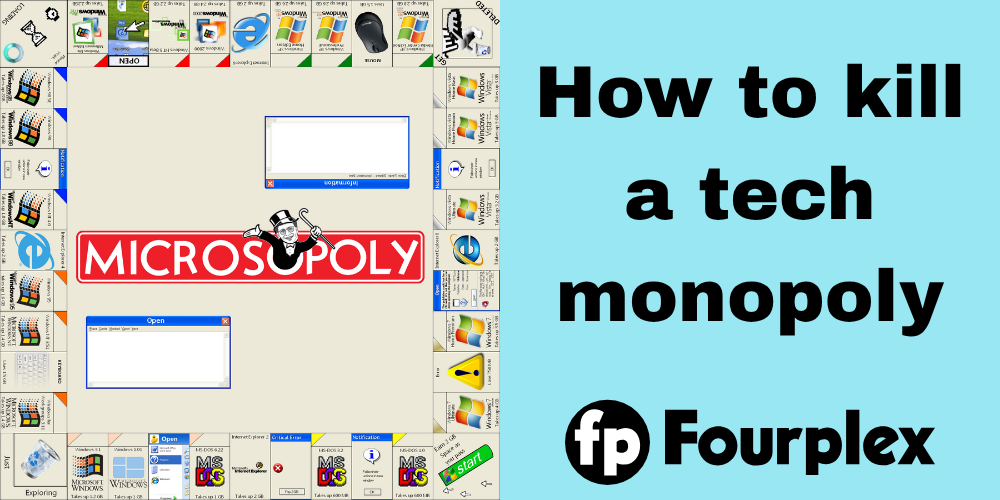
A common theme within technology startups is the “winner takes all” mentality, where one tech company dominates a particular sub-industry. Examples include Google (search engines), Microsoft (productivity software) and Meta (social media)
However, technological advancements can often kill a former monopoly, as was the case with Microsoft and Internet Explorer (lost to Chrome) and cable broadband (losing to fiber and 5G wireless).
Here, we will focus on Internet Explorer’s rise and fall.
How Internet Explorer rose
Like today’s AI boom, the internet was exploding in popularity in the 90s. Then, the most popular browser was Netscape, and most client machines ran Windows.
But Bill Gates, the CEO of Microsoft at the time was worried: Netscape would make Windows a commodity. In fact, Netscape’s co-founder Marc Andreessen said Netscape would “reduce Windows to a poorly debugged set of device drivers.” It was code red for Microsoft to aggressively move into the browser market.
As Netscape’s business model was selling browsers to corporate customers, Microsoft decided to bundle Internet Explorer for free. This way, companies are discouraged from buying Netscape, and employees get used to Internet Explorer. Microsoft also used contracts with both PC manufacturers like Dell and even Apple to prevent them from bundling Netscape or Opera.
But price wasn’t the only thing in IE’s favor: Microsoft had 100 engineers working on IE in 1996. That rose to 1,000 engineers in 1999. Many of Microsoft’s best engineers were put on Internet Explorer. It was a gold rush.
Many web technologies came from IE, most notably CSS, RSS and AJAX. IE’s rise even led to Microsoft’s infamous 1998 antitrust case.
And by 2004, Internet Explorer went to 95% market share. But from there, it was downhill.
Internet Explorer’s downfall
While Internet Explorer was the best browser in the early 2000s, during the development of Windows Vista Microsoft focused on C# and .NET. With that, they pivoted from Internet Explorer and HTML to C# and WPF (Windows Presentation Format), leaving IE to rot. This was a big mistake.
During the years, Internet Explorer became frustratingly slow and insecure. It took months for security bugs to be patched in IE, leaving users vulnerable.
Mozilla Firefox
Little did Microsoft realize was Netscape’s code was open sourced and turned into Firefox. Mozilla in the mid-2000s became aggressive, not only building a faster and more secure browser, but popularizing features such as tabbed browsing, addons and pop-up blocking.
And unlike Internet Explorer which relied on slow Windows update cycles, Firefox released new versions like hotcakes. Security bugs were patched quickly. Firefox also ran on more operating systems when IE, including less popular systems like Linux and older Windows versions.
Apple Safari
It wasn’t just Mozilla. Microsoft abandoned the Mac version of IE during Vista’s development. In turn Apple turned to the open source KDE project to build Safari. This not only left out Macs, Microsoft lost out on building the iPhone and iPad browser. This would’ve given Microsoft a foot in Apple devices considering Windows Phone failed.
And considering how successful the iPhone and Apple became, Microsoft could’ve embraced the iPhone and made Bing and Microsoft services a default, even if Microsoft rivals Apple on laptops and desktops. Instead, we all know the default search engine on Safari.
Chrome’s Rise
But while Firefox and Safari never toppled Internet Explorer, one browser did: Google Chrome. You see, Google had a major advantage: the Google.com home page. That was free marketing for Chrome.
For years, Chrome was the fastest browser, beating everyone else. Chrome won hearts and minds, and ended up dominating the browser share on desktops and Android. Chrome may only have 70% market share, but today’s internet is much larger making Chrome bigger than IE was in it’s heyday.
Chrome also had an open source base called Chromium. This became the basis for competing browsers including newer versions of Opera, Brave, Vivaldi, and Microsoft’s current Edge browser. In fact, Brave and Vivaldi were respectively founded by Mozilla’s and Opera’s co-founders after being unhappy with the direction of their former employers.
A failed revival
Going back, Microsoft was desperate. They re-focused on Internet Explorer during the Windows 7 and 8 days. But despite having a competitive browser, didn’t have the same success. Internet Explorer’s brand was tarnished, people were abandoning IE. Not to mention the rise of Apple and Android, which came with non-Microsoft defaults.
With Windows 10, Microsoft tried to build a new browser Edge. Initially, Edge ran on Microsoft’s proprietary technology like IE. But it wasn’t compatible with many websites, due to declining market share. Most people used Edge to download Chrome and nothing else.
Microsoft also started to make it annoying to set another default. For instance, they use pop-ups to get people not to download Chrome, and requiring people to select another browser manually to change the defaults.
But that didn’t work. In 2018, Microsoft moved Edge to Chromium’s open source code. That made Edge more competitive, and also able to be cross-platform. While Microsoft has gotten some market share, they’re nowhere close to topple Google Chrome. And people simply prefer Chrome now.
Conclusion
It’s easy to build a monopoly, whether by building a better product or by anticompetitive actions. But it’s also easy to lose a monopoly, whether by a well-funded rival or technological advancement. With Internet Explorer, it was dethroned by both Google Chrome and mobile devices.
Cable companies are another example: for years Xfinity and Spectrum became known for bad service, but had broadband monopolies. When fiber and 5G came, it won hearts and minds away from cable. Phone companies like AT&T are well resourced to take on cable, and had the necessary footprint and easements to overlay fiber.
And even if a monopoly can survive, like Adobe Photoshop, competition is good for consumers and businesses. In fact, it might have been better for Internet Explorer and cable operators to not have been monopolies than to be one. A non-monopoly would continue improving their product, whereas an ex-monopoly wins everything and stagnates, tarnishes their brands and loses market share to newfound rivals.
Likewise, with VPS hosting, while it’s more of an oligopoly than a monopoly, competitive choice exists. Yes, you could use the giants such as Amazon AWS and Microsoft Azure. But for most VPS use cases, services including Fourplex’s Ryzen VPS are more affordable, simpler, and faster than the giants.